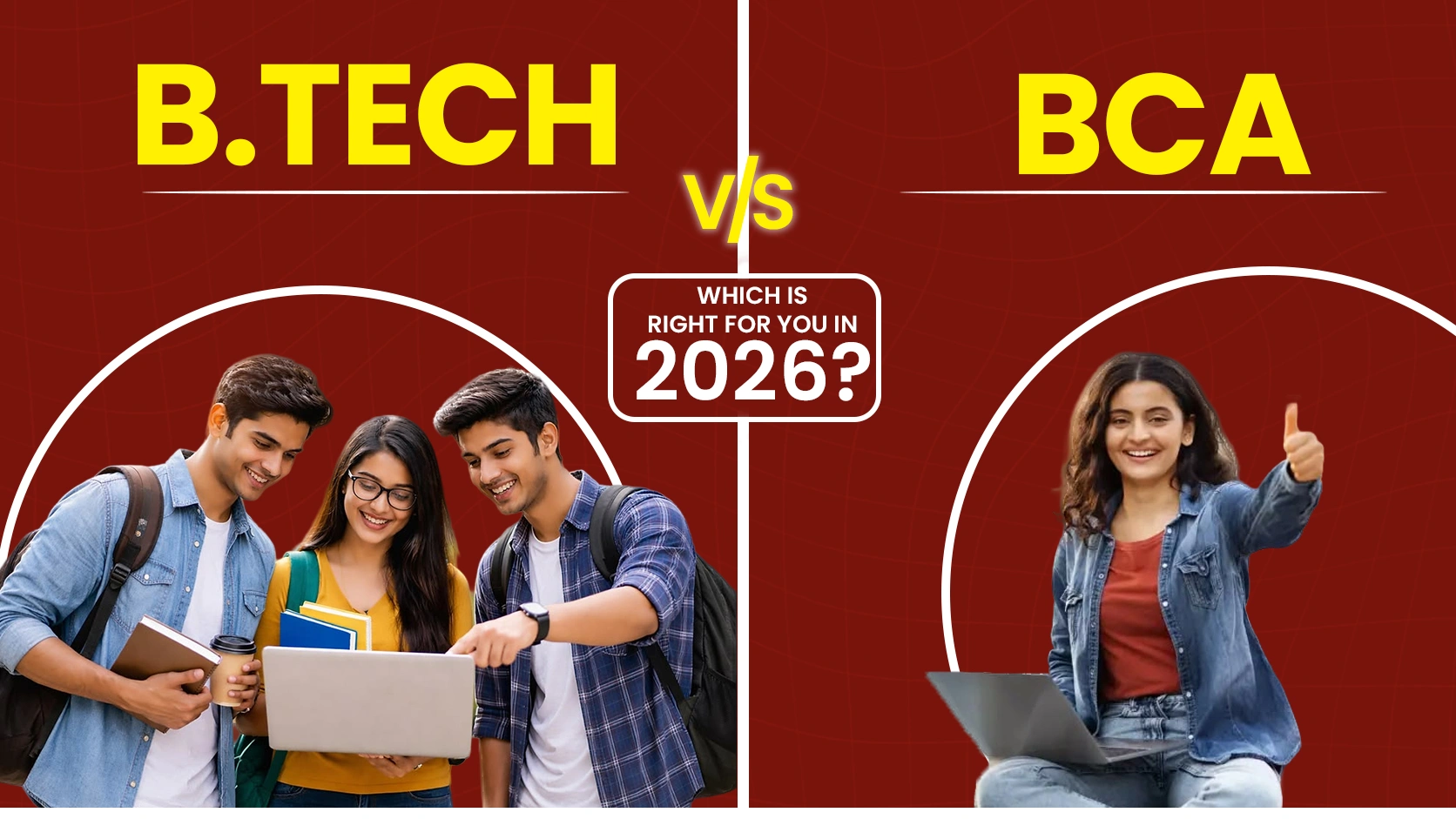
B.Tech vs BCA: Which Is Right for You in 2026?
Building a tech career is no easy task, where students struggle with a rigorous syllabus and a highly competitive job market and competition. But before that comes the toughest challenge: How to start building a career in tech?
Most students are often confused between two degrees, i.e., B.Tech and BCA, which are often considered the same but differ in career path, jobs, and future scope. If you are planning to build a career in tech, you don’t have to choose a degree because your family suggested so or your friend enrolled in a course.
In this blog, find out what degree suits your interests and build a path on your own with proper career guidance.
How Are BCA & B.Tech CSE Degrees Similar?
Let us first understand why both degrees are often considered similar.
- IT & Technology: Both degrees offer a career path in IT & technology domains like software development, AI & ML, cloud computing, web development, etc.
- Core Curriculum: BCA & B.Tech CSE share a similar curriculum, covering core computer science concepts such as programming languages, database management systems, data structures, and networking.
- Career Opportunities: Both fields offer job opportunities in similar profiles, including software developers, application developers, system analysts, and network administrators. The gap in salaries for BCA graduates can be easily managed by doing additional certification courses in the domains listed below:
- AI & ML
- Data Science
- Full Stack Development
- Data Analytics
- Cloud Computing
- Ethical Hacking
- Mobile Application Development
- Cybersecurity
- Career-ready Professionals: Both courses build professionals with a technical skillset, making them ready for industries in their respective specializations.
Deciding between B.Tech & BCA can be tough for students exploring courses after 12th grade in the tech field. To choose a course, you must understand the program details of both courses.
BCA
BCA is a 3-year undergraduate program (divided into 6 semesters), which covers core technical subjects including Programming in C, C++, Java, Python, Database Management Systems (DBMS), Operating Systems, Data Structures, Web Technology, and Software Engineering.
The eligibility criteria for BCA vary for different institutes, but typically, the students must have cleared 10+2. Some colleges and universities require PCM as an eligibility criterion, but in some private institutions, non-PCM students can pursue the course as well.
Admission Process for BCA
Most colleges have merit-based admissions, which are typically defined by 12th board results, CUET-UG, and JEE percentile. Certain universities and colleges also conduct entrance exams for admission.
B.Tech
B.Tech is a 4-year undergraduate program (divided into 8 semesters), with different disciplines including B.Tech CSE, B.Tech ECE, B.Tech AI & ML, B.Tech Data Science, B.Tech Civil Engineering, B.Tech Mechanical Engineering etc. Out of the different disciplines offered in B.Tech courses, B.Tech CSE is closely related to BCA because of similar core subjects like programming languages, coding, data structures, etc.
Admission Process for B.Tech
Admission process for different B. Tech courses in top colleges like IITs, NITs, etc., are often based on JEE Main & Advanced results. Apart from the JEE percentile, some institutes may conduct their own entrance exams, which help students avail exclusive scholarships to fund their education.
The students must have cleared their 10+2 with PCM, and the minimum percentage may vary for different specializations in B.Tech.
|
BCA |
B.Tech |
| Duration |
3 Years |
4 Years |
| Eligibility |
PCM (Many institutes take candidates with non-PCM backgrounds as well) |
Cleared 10+2 with PCM |
| Approach |
Application-based |
Focus on intensive theoretical & practical knowledge with live projects |
| Subjects |
Programming, Web, AI, Data Science, Digital Marketing |
Algorithms, OS, Architecture, Networks, Deep Learning, AI & ML, Data Science |
| Tools & Technologies |
SQL, HTML/CSS, basic networking tools |
Operating systems, networks, AI tools, advanced frameworks, Blockchain, LLMs, and AI frameworks |
| Specialization |
Full Stack Development, Digital Marketing, Cyber Security, Gen AI |
CSE, Artificial Intelligence, Data Science, Deep Learning |
| Industry Exposure |
Focus on practical application |
Exposure to real-world projects and internships |
- Course Duration: The most important difference between the B.Tech CSE & BCA programs is the course duration, i.e., 3 years for BCA & 4 years for B.Tech.
- Academic Structure: B.Tech CSE & BCA both cover almost similar technologies as a foundation, including programming languages, algorithms, web development, etc. The key difference is the academic structure of both courses, which is discussed below:
|
B.Tech CSE |
BCA |
| Structure |
Broader engineering & mathematical concepts |
Covers practical programming |
| Focus |
B.Tech CSE covers hardware, theory, and in-depth software development. |
BCA is an application-focused course. |
| Curriculum |
Major focus on intensive topics like Data Structures, Algorithms, Computer Architecture, Operating Systems, and Advanced AI. |
Major focus on Programming Languages, Database Management, and Application Tools. |
| Curriculum Complexity |
B.Tech CSE is considered more rigorous because of in-depth knowledge, advanced mathematics, and complex theoretical concepts. |
BCA is more practically focused on software applications and IT, with a les |
- Career Paths: B.Tech graduates have an advantage over BCA graduates because the 4-year engineering-focused curriculum provides deeper theoretical knowledge and hands-on industrial training. Whereas BCA focuses more on practical programming and application development.
| Jobs After B.Tech CSE |
Jobs After BCA |
| Software Developer/Engineer |
Full-Stack Developer |
| Data Scientist |
Data Analyst |
| AI/Machine Learning Engineer |
Cybersecurity Analyst |
| Cloud Engineer |
DevOps Engineer |
| UI-UX Developer |
Blockchain Developer |
| Web Developer |
System Administrator |
| Database Administrator |
Systems Analyst |
| Cloud Computing Professional |
Digital Marketing Specialist |
| UI/UX Designer |
|
- Earning Potential: The in-depth engineering degree focus in B.Tech enables B.Tech graduates to earn better than BCA graduates. While there is a difference in earning potential, BCA graduates can upskill using certifications, diploma courses, and specializations to cover the salary gap that B.Tech & BCA graduates have.
Also Read: Diploma Vs Degree – Which One Should You Choose?
- Cost: Typically, BCA courses cost less than B.Tech courses, making BCA an affordable degree.
- Domain Specialization: The B.Tech course offers students a greater variety of specializations like AI & ML, Data Science, Deep Learning, and many more. On the other hand, BCA offers specialisations such as AI & GenAI, Full Stack Development, Digital Marketing, and Cybersecurity.
- Industrial Exposure: B.Tech students can actively participate in live technical projects, industrial training, internships, & technical training, making them industry-ready, whereas BCA offers limited industry integration.
- B.Tech vs BCA Salary: B.Tech graduates often have access to higher-paying technical roles and may earn higher starting salaries, particularly from reputed institutions. However, actual salaries depend on skills, specialization, employer, and location.
B.Tech CSE vs BCA: How to Choose Your Tech Career
Students are often confused between choosing BCA or B.Tech CSE for pursuing their undergraduate course. To help you decide, here’s a guide that will help you choose whether you should pick BCA or B.Tech CSE in your undergraduate program.
- What is Your Academic Qualification?
The first thing to consider is your academic background. The B.Tech program requires you to have completed your 12th in PCM, whereas for BCA, students from a non-PCM background can also apply to some colleges and universities.
- What are Your Career Goals?
If you want land jobs with core engineering roles, which may include advanced development or research projects, a B.Tech will be more suitable. For development and technical roles at an early stage, a BCA degree is preferred.
- What Technical Depth of Subjects Do You Prefer?
B.Tech specializations cover core engineering topics in depth, whereas BCA follows a more practical approach.
- Consider the Course Duration
BCA is a 3-year course, whereas B.Tech is a 4-year course, which offers earlier entry into career lines for BCA students.
- Compare the Course Cost
BCA degrees are usually cheaper than B.Tech courses, which is an important factor to consider when choosing between the two degrees.
How Should BCA Students Prepare For Better Career Opportunities & Salaries
Internships & professional certifications help BCA students gain technical expertise and practical exposure, which is often a limitation compared to the B.Tech curriculum. Here are some tips for BCA graduates to level up in addition to their regular degree:
- Work on Practical Projects
Learn practical applications of concepts you learn with hands-on experience with full-stack development, mobile applications, data analysis tools, etc.
- Cover the Technical Gap
BCA students need to cover the gap in theoretical and practical knowledge. Students can enrol in diploma or certification programs to strengthen their fundamental concepts with specializations like AI & ML, Data Structures and Algorithms (DSA), operating systems, and computer networks.
- Build an Impressive Portfolio
Building a strong portfolio is important, where students should highlight their technical projects for mobile app development, full-stack development, digital marketing projects, etc.
- Gain Practical Exposure
Start internships within the first/second year of your program to get industrial experience.
- Higher Education
Pursuing higher education in MCA is one of the best options for BCA, as MCA offers better career opportunities and better paychecks.
Still confused?
Talk to our counselors and find out which course best suits your academic qualifications, interests, and career prospects.
Frequently Asked Questions
- Is B.Tech tough or BCA?
B.Tech is considered to be tougher than the BCA program because of its theoretical depth, advanced mathematics (Calculus, Linear Algebra), and core engineering principles.
- What is the fee comparison for both courses?
BCA is typically cheaper than B.Tech.
- Is BCA still in demand?
Yes, BCA is still in demand with job opportunities in the IT sector in roles like Front-End Web Developer, System Administrator, Database Administrator, Systems Analyst, & Cloud Computing Professional.
- Which course is best for 100% placement?
Both courses offer job security, but placement depends on your academic performance, technical skills, and practical knowledge.
Check more updates and pics on our social media.