



The world is talking about coding, AI, and digital transformation. So, maybe you are left with the thought – How do emerging technologies compare to agriculture even a bit? Is agriculture one of the next-gen courses that remains relevant to the modern industry’s needs and technology?
The answer is yes! Modern agriculture has transformed, reforming how we view traditional farming. The integration of technologies (like drones, AI-driven automation, or agricultural robotics) has made the otherwise thought to be a regular agriculture degree a game-changing career path.
With no delay, let us explore the future scope and career opportunities after pursuing a B.Sc. Agriculture:
B. Sc. (Hons) Agriculture is a four-year undergraduate program offering a strong foundation in the science and practice of agriculture.
The curriculum for agriculture covers the core concepts, including Agronomy, Horticulture, Soil Science, Organic Farming, Hydroponics, Mushroom Production, Composting, Disease & Pest Management, and Integrated Nutrient Management.
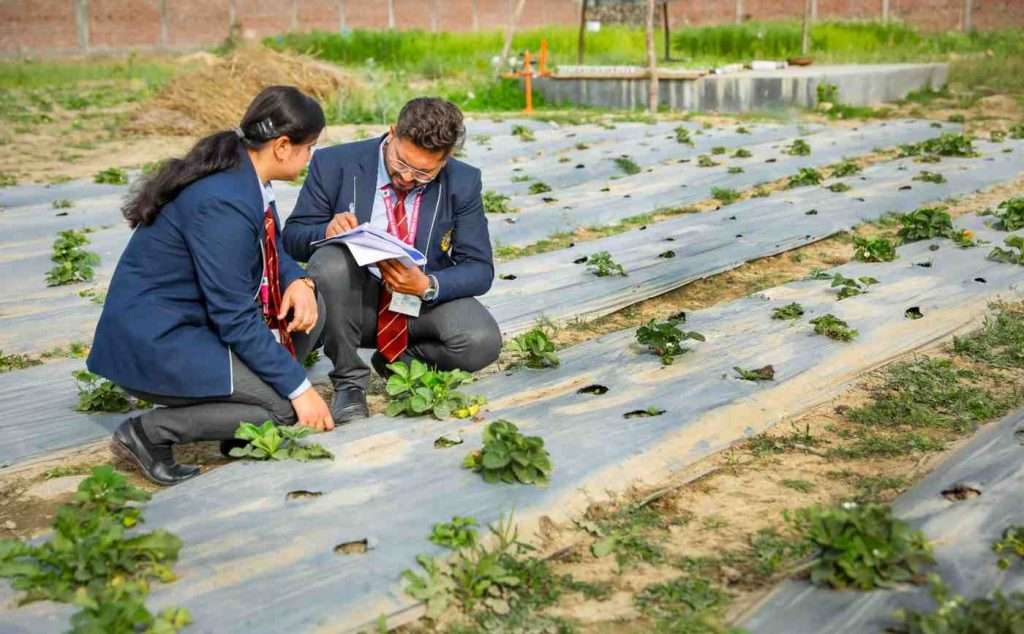
The B.Sc. Agriculture course equips students with theoretical and practical training, helping them gain skills required for the industry standards. Hands-on training with agricultural farm work enables students to gain practical experience in the core concepts of the subject.
Upon completion of the undergraduate program, students can further choose specializations in their master’s program. Some of the demanding specializations in Agriculture include:
Note: At Shivalik College of Engineering, we follow an advanced curriculum that aligns with the global industry demands of Agriculture. Our course adheres to the curriculum recommended by the Fifth Deans’ Committee of ICAR.
The modern agricultural practices utilize advanced techniques and technologies that enhance productivity and efficiency in production and processing. Some of the most popular B. Sc. Agriculture subjects are listed below:
| Topic | Focus Area |
|---|---|
| Agronomy | Focuses on the principles and practices of crop production and soil management |
| Horticulture | Focuses on the cultivation of plants for food, medicinal purposes, and aesthetic enjoyment. |
| Soil Science | Focuses on the study of soil properties and their impact on crop production and overall land management |
| Organic Farming | Focuses on agricultural production systems that avoid or largely exclude synthetic inputs like chemical fertilizers and pesticides. |
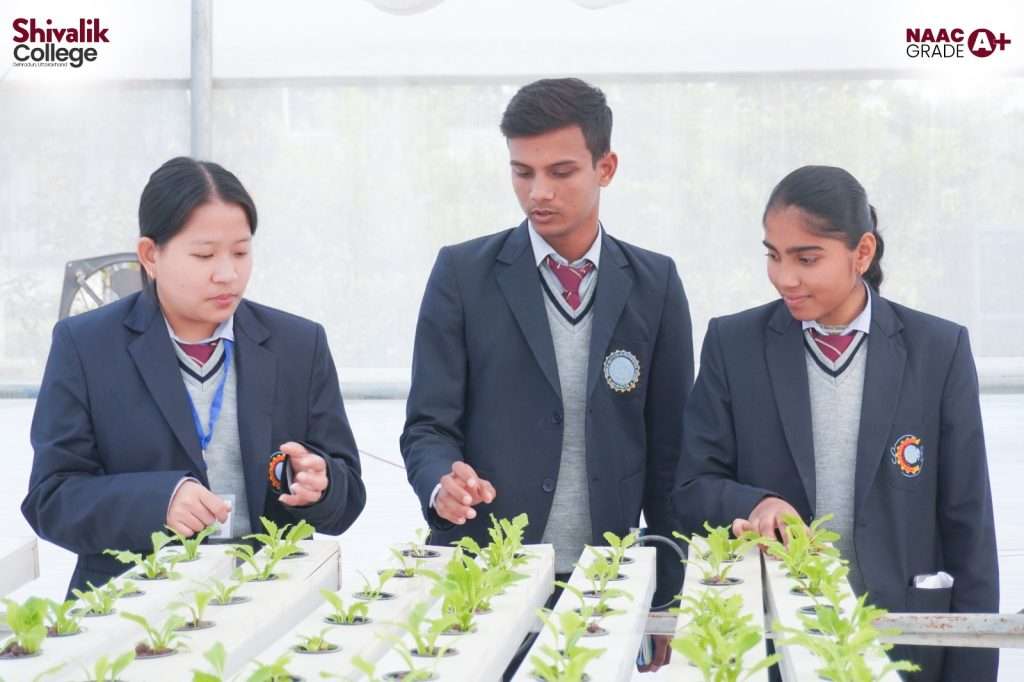
| Hydroponics | Focuses on the technology of growing plants in a nutrient-rich solution instead of soil |
| Mushroom Production | Focuses on cultivating various species of fungi, primarily for food and potentially medicinal purposes. |
| Composting | Focuses on the strategic management of organic waste to produce nutrient-rich compost, which is then used to enhance soil health and crop productivity. |
| Disease & Pest Management | Focuses on protecting crops from damage caused by diseases and pests |
| Integrated Nutrient Management | Focuses on the maintenance of soil fertility and of plant nutrient supply to optimize crop yields while maintaining soil health and minimizing environmental impact |
In this section, let us explore some best career options after completing a B.Sc. Agriculture:
The government sector offers diverse career opportunities with high stability in reputed organizations like ICAR, FCI, IFFCO, NABARD, and State Agriculture Departments.
Some of the B.Sc. agriculture job roles in the government sector include:
Apart from the government sector, B.Sc. Agriculture opens doors to various job opportunities in the private sector. Some of the top recruiting industries include:
Once a student gains all the fundamentals of Agriculture, they can aim to become agripreneurs, establishing and scaling an agri-based startup. Blending innovation with smart agricultural practices, the agripreneurs of the modern age can address national and global concerns of hunger and food insecurity.
For instance, Mr. Chandramani Kumar, an alumnus of Shivalik College of Engineering [course – B.Sc. (Hons) Agriculture], has successfully launched a business, Agri Joy Private Limited.
Learn more about the achievements of the best B.Sc Agriculture College in Dehradun!
While most graduates opt for jobs after completion of their undergraduate programs, pursuing higher education to gain expertise is one option students can consider.
M.Sc. in Agriculture is a two-year post-graduate program, offering focused and advanced knowledge in agricultural sciences and food production technology.
Students can either pursue a core MSc program or a specialization program in the following top M.Sc. Agriculture courses:
Apart from these, students can also pursue the following master’s program:
MBA in Agribusiness Management: It is a 2-year program focusing on the management and administration of the agricultural industry. The course covers core concepts of business operations, including agribusiness economics, finance, marketing, supply chain management, and international trade.
Additionally, after completion of their undergraduate degree in B.Sc. Agriculture, students can also prepare for competitive exams in India, like:

1. Sustainable agriculture is one of the emerging trends focusing on environmental health, economic profitability, and social equity. The farming approach with sustainable agriculture highlights the production of food and other agricultural products without compromising the ability of future generations to meet their needs.
2. Digital transformation and AI usage in farming practices are another area in agriculture with potential growth. Core digital technologies that are driving transformation in agriculture include Cloud computing, IoT, Blockchain, AI, and Big Data.
| Stage | Technology | Use |
|---|---|---|
| Production | IoT, Sensors, GNSS | Precision agriculture, soil & crop monitoring |
| Processing | Automation, AI | Waste reduction, quality control |
| Distribution | Blockchain, AI | Traceability, logistics, food safety |
| Consumption | Online platforms | Demand forecasting, direct sales |
| Disposal | Analytics, Robotics | Waste management, recycling |
Source: ScienceDirect
3. Precision Agriculture utilizes data-driven technologies to increase efficiency, productivity, and sustainability in farming. Key technologies used are:
4. Agricultural Robotics uses automated robots in various farming processes to boost productivity and efficiency.
5. Vertical Farming adopts vertically stacked layers for agriculture, using modern agricultural practices like hydroponics, aquaponics, and aeroponics.
In addition to these, there are numerous other advancements in agriculture that have given rise to innovative farming practices, including:
B.Sc. Agriculture is no longer just about traditional farming but a dynamic, future-ready program that integrates science, sustainability, and technology. With hands-on training and practical application of the subject, the course opens multiple career paths.
Have any questions? Drop them in the comments below, and our experts will respond to your queries.
For more updates, visit our official website: https://shivalikcollege.edu.in/
Follow us on:
Yes, B.Sc. Agriculture is a good career choice because it offers diverse career opportunities, job security, and growth potential.
Candidates who have completed 10+2 (or equivalent) examination with PCB (or Maths) from any recognized Board are eligible for B.Sc. Agriculture. Learn more about the B.Sc. agriculture fee structure: Click here!
After completing a B.Sc. Agriculture degree students can apply for jobs in both private and government sectors, with the following job profiles: